Evaluation Metrics — Confusion Matrix & Beyond
Exam Importance
HIGH | 2 out of 3 exams (2024 Q3, Practice Q4) — 7 marks total
Feynman Draft
Imagine you're a doctor testing patients for a disease. You have 100 patients. Your test says 25 are sick. But how good is your test really?
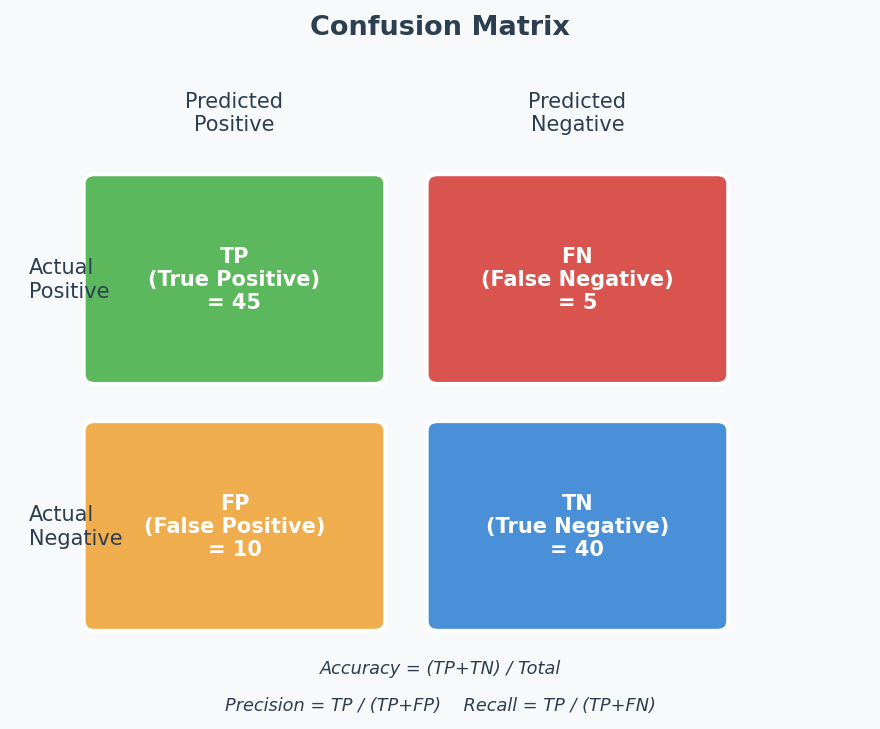
The Confusion Matrix(混淆矩阵) breaks down exactly what happened:
                    Actually Sick    Actually Healthy
Test says "Sick"     TP (True Pos)    FP (False Pos)(假阳性/误报) ← "False alarm"
Test says "Healthy"  FN (False Neg)   TN (True Neg)(真阴性)      ← "Missed case"
                     (真阳性)        (假阴性/漏报)
The 3 key metrics:
| Metric | Formula | In Doctor Terms | When It Matters |
|---|---|---|---|
| Accuracy(准确率) | (TP+TN) / All | % of ALL patients diagnosed correctly | General performance |
| Precision(精确率) | TP / (TP+FP) | Of patients told "sick", how many really are? | When false alarms are costly |
| Recall(召回率) | TP / (TP+FN) | Of actually sick patients, how many did we find? | When missing a case is dangerous |
Toy Example (2024 Q3):
                True Positive    True Negative
Predicted Pos      500              400
Predicted Neg        0              100
- Accuracy = (500 + 100) / 1000 = 60%
- Precision = 500 / (500 + 400) = 500/900 = 55.6%
- Recall = 500 / (500 + 0) = 100%
Interpretation (this is worth marks!): The model has perfect recall (catches ALL positives) but terrible precision (55.6% of its "positive" predictions are wrong). It achieves this by predicting almost everything as positive — like a doctor who tells every patient they're sick. That's not useful!
Common Misconception: "High accuracy = good model." WRONG! If 99 out of 100 patients are healthy and your model always says "healthy", accuracy = 99%. But recall = 0% — you missed every sick person. Always check precision AND recall, especially with imbalanced classes.
Toy Example 2 (Practice Q4):
                True Positive    True Negative
Predicted Pos        5               20
Predicted Neg       10               65
- Accuracy = (5 + 65) / 100 = 70%
- Recall = 5 / (5 + 10) = 5/15 = 33.3%
Interpretation: Accuracy looks decent (70%), but recall is awful (33%). The model only finds 1 in 3 sick patients. This is because the data is class imbalanced(类别不平衡) — 85 negatives vs 15 positives. The model learns to mostly predict "negative" because that's the safe bet for accuracy.
The Class Imbalance Trap (Exam Favourite)
Pattern the teacher uses: Give you a confusion matrix where accuracy looks "OK" but precision or recall reveals the model is actually terrible at one class.
How to spot it:
- Calculate all metrics
- Check if positives and negatives are balanced
- If one class dominates → accuracy is misleading → look at per-class metrics
How to answer the "What do you think?" question:
- State the numbers (accuracy, precision, recall)
- Observe: "The model is [good/bad] at classifying [positive/negative] examples"
- Explain: "This is because [the model predicts most examples as X / the classes are imbalanced]"
- Conclude: "If we care about [finding positives/avoiding false alarms], this model [does well / performs poorly]"
Quick Reference: All Formulas
$$\text{Accuracy} = \frac{TP + TN}{TP + TN + FP + FN}$$
$$\text{Precision} = \frac{TP}{TP + FP}$$
$$\text{Recall (Sensitivity)} = \frac{TP}{TP + FN}$$
$$\text{F1 Score(F1分数)} = \frac{2 \times \text{Precision} \times \text{Recall}}{\text{Precision} + \text{Recall}}$$
When to use F1: When you care about BOTH precision AND recall equally but the classes are imbalanced. F1 is the harmonic mean(调和平均数) — it penalises extreme imbalance between precision and recall. A model with precision=100%, recall=1% gets F1≈2%, not 50.5%.
Example from Mock Exam 2: Precision=70%, Recall=70% → F1 = 2×0.7×0.7/(0.7+0.7) = 70%. Equal precision and recall → F1 equals both. But if Precision=90%, Recall=10% → F1 = 2×0.9×0.1/(0.9+0.1) = 18% — F1 reveals the model is bad despite high precision.
Memory trick:
- Precision = "of all my Positive predictions, how many were right?" (P for Predicted)
- Recall = "of all Real positives, how many did I find?" (R for Real)
English Expression Templates
Calculating:
- "The accuracy is (TP+TN)/(TP+TN+FP+FN) = ..."
Interpreting:
- "The model achieves high recall but low precision, indicating it predicts most instances as positive."
- "Despite the seemingly acceptable accuracy of 70%, the model performs poorly at identifying positive instances, with a recall of only 33%."
- "This discrepancy is due to class imbalance in the dataset."
Confusion Matrix Diagram
中文思维 → 英文输出
| 中文思路 | 考试英文表达 |
|---|---|
| 准确率高不代表模型好 | "Despite the seemingly high accuracy, the model may be performing poorly — this is common with class-imbalanced datasets." |
| 模型把什么都预测成正类了 | "The model predicts almost everything as positive, achieving high recall but at the cost of many false positives." |
| 类别不平衡导致准确率有误导性 | "The high accuracy is misleading due to class imbalance — the model simply predicts the majority class." |
| recall高但precision低说明误报多 | "High recall with low precision indicates the model catches most positives but generates many false alarms." |
| F1综合了precision和recall | "The F1 score is the harmonic mean of precision and recall, providing a balanced measure when both metrics matter." |
本章 Chinglish 纠正
| Chinglish (避免) | 正确表达 |
|---|---|
| "The accuracy is 70% so the model is OK" | "The accuracy of 70% may be misleading — examining precision and recall reveals the model's true behaviour" |
| "The model can find all the positive" | "The model achieves perfect recall, identifying all positive instances" |
| "Because data is not balance" | "This is due to class imbalance in the dataset" |
Whiteboard Self-Test
- Can you draw a confusion matrix and label TP, TN, FP, FN?
- Can you calculate accuracy, precision, and recall from any matrix?
- Can you explain why 70% accuracy might actually be a bad model?
- What does recall=100% with precision=56% tell you about the model?