MiniTorch
Fast NumPy autograd, compiled dense training, and inspectable neural networks.
MiniTorch is a compact scientific-computing framework for learning and experimenting with reverse-mode automatic differentiation. Its Python surface stays readable while first-order backpropagation uses raw NumPy gradient kernels and static dense classifiers can move the complete training loop into compiled C.
-
:material-lightning-bolt:{ .lg .middle } Fast backpropagation
A linear-time reverse tape visits every graph node and edge once, without constructing a second graph during ordinary first-order training.
-
:material-language-c:{ .lg .middle } Compiled training
Dense
Linear/ReLUclassifiers can run batching, forward, backward, softmax cross-entropy, and Adam in generated C while NumPy calls BLAS. -
:material-graph-outline:{ .lg .middle } Scientific model explorer
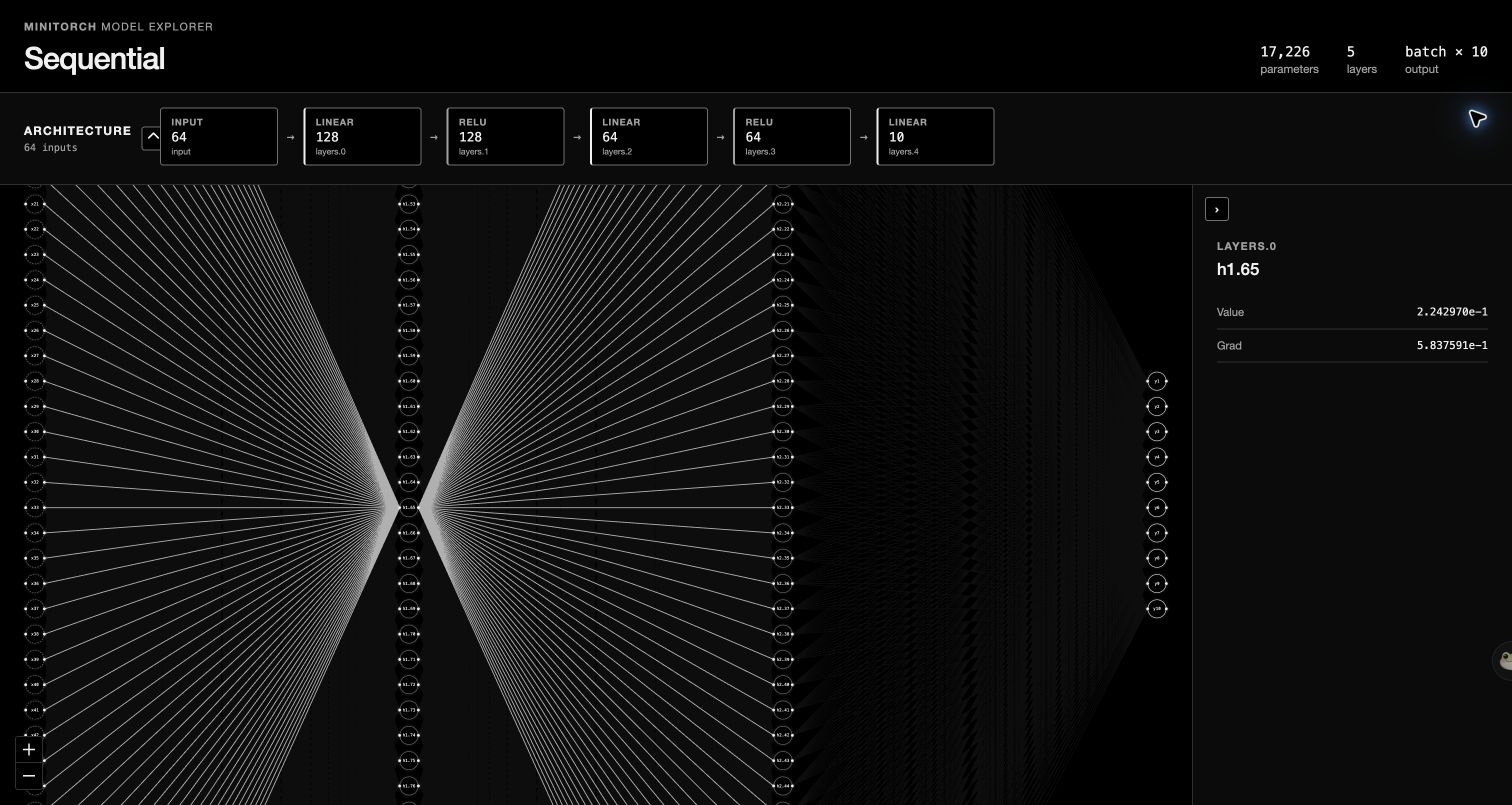
visualize(model)opens a self-contained full-neuron connection map. Selecting a neuron shows only its latest value and gradient.
Get started Explore the model viewer
Thirty-second example
import numpy as np

from MiniTorch import Variable

x = Variable(np.array([[2.0]], dtype=np.float32), name="x")
w = Variable(np.array([[3.0]], dtype=np.float32), name="w")
b = Variable(np.array([[1.0]], dtype=np.float32), name="b")

loss = (x * w + b - 10.0) ** 2
loss.backward()

print(loss.data)    # [[9.]]
print(w.grad.data)  # [[-12.]]
Choose a training path
Use eager execution for custom modules, dynamic Python control flow, new operations, or higher-order gradients.
Inspect the trained network